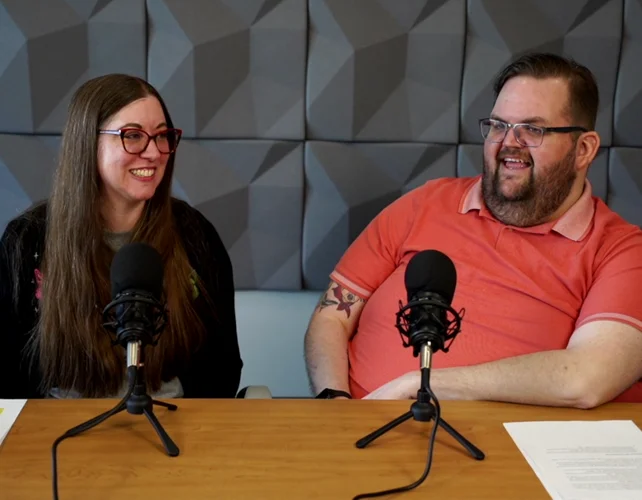
 Jenny and Daniel
Season 6, Episode 1: Ask Us Anything, We're Librarians
March 20, 2026
In this episode, podcast host Daniel Pewewardy is joined by new co-host Jenny Durham to kick off Season 6 of the Read Return Repeat podcast. They talk a little about the history of public libraries, how they became librarians and answer audience questions about the work they do behind the scenes.
This transcript was generated using Adobe Premiere Pro and was reviewed for accuracy by a member of the Library's Digital Services team before publishing. If you find a transcription error, please contact us with any corrections and we will make those corrections as quickly as possible.
[music]
Daniel
Hello, everyone. Welcome to Read Return Repeat season six. I'm your host, co-host, inspiration librarian Daniel Pewewardy.
Jenny
And I am Jenny Durham, the, enrichment librarian.
Daniel
So new season, new format. I guess kind of tell me what's... Jenny has been on the show before, and so we're going back to two hosts, I think. We'll see. We don't know.
Jenny
Yeah, we'll see what happens.
Daniel
But we're also going to do, go ahead and tell us like what, how we're doing the show.
Jenny
Yeah. This is going to be a little bit more conversational than we've done in the past. We may throw in some episodes here and there where we interview authors. But we'll kind of go off of a theme.
Daniel
Yeah. So, every, every episode, we're, we're trying to do something more conversational. And having authors is great, but like, it was kind of becoming a big task, kind of, like book authors. And so we thought just like, kind of—I don't, well, we don't need to get into the details of why we're doing this, but I will say that the one thing that we are trying to just have a conversation, we'll have more like other librarians on the show, and every episode is going to have a theme.
Daniel
So yeah, so it's a little loose. This is, season six is, we're just kind of taking it easy and seeing how it goes. So yeah, and I guess we'll just start.
Jenny
And you might learn some interesting stuff. So it's more of a deep dive.
Daniel
Yeah.
Jenny
Into things. But we were going to do a deep dive for this episode into libraries because it is the 150th anniversary of the Wichita Public Library this year.
Daniel
Yeah. So yeah, I guess we can talk about that real quick. So tell us, you've done some research, so, like, I guess for people that don't know, like, do you have something like, how did library start in America?
Jenny
Yeah. This is actually really interesting history. And those of us who went to library school might know some of this, but your average person isn't going to know some of the stuff that we like take for granted. So libraries, public libraries in the United States, we can actually thank Benjamin Franklin. Initially before the Revolutionary War, they were actually more subscription-based, which meant that they were not technically free and public or taxed, like they are today. They were—
Daniel
So like libraries were a subscription, were subscription based.
Jenny
Kind of, pretty much, like if anybody is familiar with like in Europe, they had these literary salons, which it wasn't like salon today. It was very much like a space where wealthy men usually would meet together to talk about, like, philosophy or religion or science.
Daniel
So like book clubs for, like, the Founding Fathers.
Jenny
Pretty much, yeah. And they paid a monthly fee. And they were basically investing, and that money went towards basically purchasing books that they were sharing. And so Benjamin Franklin started the first one of these types of libraries, which he called the—
Daniel
Because if you didn't know, Benjamin Franklin was a freak and went to France a lot. Like I have to keep this like PG. I... yeah, you said Ben Franklin. We open up a whole rabbit hole. I don't know, that guy just... yeah, that guy was different. He was built different. And you know, and he helped make America. So shout out to Ben Franklin.
Jenny
Yeah.
Daniel
Ben Frank-freak-lin, as I like to call him, because that boy.
Jenny
So he had a, so he opened his subscription library. He called it the library company. And—
Daniel
He would.
Jenny
Yeah. Yeah.
Daniel
Yeah.
Jenny
And basically later on, I think this was after the Revolutionary War, he, he wanted to make these books available to more than just, you know, paying members or whatnot.
Daniel
Like he envisioned as a, as a way to just like, you know, like for the general public and then... still probably what he wanted it was for, you know, like, all was like white men, Christian men that owned property.
Jenny
Pretty much. What was actually interesting is that, like this little library company, we're kind of going still with his little subscription is that people that weren't members could technically borrow the books, but they had to put down collateral.
Daniel
Ohhh!
Jenny
So it was like, you know, yeah, like when you put, like, hey, you can... I mean, wouldn't have been a car, obviously, but like, yeah, here's, you know, you can take my house if I don't return my book.
Daniel
Like, here's my mule.
Jenny
Yeah. So, he did allow that, but later on, he actually donated a lot of these book collections to help form one of the first, like, libraries that was freely available. And it was, ironically, a town in Massachusetts that's named after him. So Franklin, Massachusetts got to get a library. because—
Daniel
I mean, that's just like, yeah, that's like nepotism, basically.
Jenny
Pretty much.
Daniel
Yeah.
Jenny
Yeah. But really like the first large public library that acknowledged as far as being like tax-supported and free for the public to use was the Boston Public Library, even though technically there were some smaller ones in Massachusetts that started before. But the one that's like acknowledged is the Boston Public Library as like the first official public library. And they, their collection began with 16,000 volumes.
Daniel
Oh, that's insane. Well, I've been to Boston a couple of times. I don't know where that building is, though.
Jenny
I don't think I've ever been to... yeah, I've been to Boston twice, and I've never been to the Boston library.
Daniel
If you go to Boston and you see, like, a building that looks like our old library, like the one on, Main Street, that is not the library. That is City Hall. And it looks just like, it's like a gigantic version of that building. It's really weird. Anyway, we're talking about Boston.
Jenny
Yeah. And it was in 1854 was when it officially opened. One thing a lot of people don't realize too, is that early libraries, was a male-dominated profession.
Daniel
Okay.
Jenny
Yeah.
Daniel
Yeah.
Jenny
And so it didn't actually become a more women-focused until after the 1900s.
Daniel
That, I mean, like that makes sense, right? I mean, like, men probably literacy rates among women at that time were probably lower than they were...
Jenny
Mm-hmm.
Daniel
And then I guess the men had other things to do than read books.
Jenny
Yeah, yeah. And what's interesting—
Daniel
Men of the time!
Jenny
Yeah, even at the time too, the men that were going in to work as librarians, it was like a second career or it wasn't really like—
Daniel
They're moon, they're like moonlighting as a librarian.
Jenny
Yeah. They're like, okay, I kind of want to just do this now. So I'm going to go and become a librarian.
Jenny
And they didn't really have official schools yet at that point. I think when they brought in the training, it became more of like a vocational thing, which I found very interesting because the library schools, the training was very short and it was done like in the actual library buildings. So like today, to actually be a trained librarian, like to have that official credential in the United States, you have to have a master's degree. We can go into later, like, why that is.
Daniel
Yeah. So like, yeah, we can talk. Yeah, we can talk about that later because I have some, I have some thoughts.
Jenny
That's a whole thing.
Daniel
That's a whole thing on who and who isn't a librarian.
Jenny
I don't know how many times, "You have to have a master's degree to be a librarian? Why?"
Yeah, we can go into that later. But initially it was like really short training and done like on the job. So very much like a vocational type thing. So at that point, that was when you started seeing more women going into that field because the training was short and often if like they couldn't really get into teaching or they didn't like it, it was another avenue.
Jenny
And it was one of those—
Daniel
So it was kind of like a CNA position now.
Jenny
Yeah.
Daniel
Because the training... like, like librarians were basically like, the first women librarians are basically like, because if you think about it, like CNAs used to be big burly dudes called orderlies, you know, like when they're like the big dudes, like in the 1950s and up until, like the classic Fat Boys movie Disorderlies.
But, but then it's... but then as those men exited that field, you know, with, like, the nursing assistant positions became kind of like female dominated, which I don't know why I went on that, I just...
Jenny
Yeah, no, that's really interesting, though, because even like the language around it and I think some of the stereotypes around it too, really probably reflect some of the assumptions made about librarians today that still kind of carry on.
And so I just found that really interesting. One thing that is kind of neat to look at, though, is that you had, as librarianship as a career got really popular in the northeast, those jobs got really hard to find. So a lot of these women started heading west or to these like, rural communities in the south.
And if you've heard about those, like, horse pack librarians in the 1930s, that was like started by women and they were not like your stereotypical women of the time. They were kind of like independent, roguish women.
Daniel
So like instead of carpetbaggers, they were like book baggers.
Jenny
Yeah, pretty much.
Daniel
They were going to places and be like, we're going to have—y'all gonna get literate today. [Daniel laughs]
Jenny
Yeah. So they, like, built up these libraries in these small communities and they were like the ones that really kind of started like these partnerships with the schools. Like, you know, today you have a lot of libraries that have children's departments that are closely aligned with local area schools to like, develop literacy programs.
Daniel
Yeah. I didn't know any of this. So yeah, yeah, yeah.
Jenny
Which is fascinating. And I didn't even, I don't, I didn't even know that part. I thought that was really interesting. And probably the big thing I want to bring up is that there's somebody else that's responsible for a lot of libraries existing.
Daniel
Oh no. I know who you're going to mention. He's—
Jenny
We gotta... yeah, he's—
Daniel
He's canceled.
Jenny
Yeah. He's a little—
Daniel
Melvin.
Jenny
This is—oh, no, we're not even talking about him.
Daniel
Oh, we're not talking about Melvin Dewey?
Jenny
We could.
Daniel
Oh my gosh.
Jenny
Melville Dewey. [Editor's note: He also spelled his name "Melvil Dewey" and "Melvil Dui"]
Daniel
Melville. Whatever.
Jenny
Originator of the Dewey Decimal system.
Daniel
Okay, who's this other, who's this other problem?
Jenny
I was actually going to talk about Andrew Carnegie.
Daniel
Oh! Oh.
Jenny
Who is also kind of... I have weird feelings because it's the whole Gilded Age. Like—
Daniel
He's just like—
Jenny
You know.
Daniel
Yeah, he was a robber baron.
Jenny
Yeah.
Daniel
Yeah.
Jenny
But, you know, it's not all... people aren't all bad or good. So I have mixed feelings about him. However, the reason why we have so many libraries in the United States was because of Andrew Carnegie. He, he funded the building of 2,509 Carnegie libraries worldwide between 1883 and 1929. And then of those, 1,795 were in the United States, 1,687 of those were public libraries and 108 of them were academic. And he also—
Daniel
That guy.
Jenny
—built others from around the world. I didn't even know that he also built libraries outside the United States.
Daniel
That, yeah. And like, I guess like because of that, we now are in this America where there's like a library in every community. And that kind of helps create this, like myth that, like with access to information, you can basically pull yourself up by your—it becomes... like, at this moment, I guess we can say, like libraries become a part of, like, American ideals and this idea that you can have nothing and work your way up in America and have the American dream.
And so, like, I think that's important to like, talk about is like, once we get to the Carnegie era and there, like libraries are just popping up all over the country, it's no longer just like the service that exists. It's a, it becomes because of the word public library, it becomes a part of just like the American dream or as one of the like, you know—like public schools, public library—components that help build this idea of, like, determinism and, and all that stuff.
Jenny
And I think that's a big reason why, you know, people have this romanticism around public libraries.
Daniel
Yeah.
Jenny
In the United States. They, they're like such a ubiquitous part of American culture, even for people that maybe haven't been to the library since they were a kid, it's still something that I think people that grew up in the States has a memory from when they were a child going to the library, whether or not it's a positive memory, you know, it's still a visceral memory.
Daniel
So what did Andrew Carnegie do to get his money? I forgot, he's a railroad guy, right? Or was he like—
Jenny
I think... I just knew, or was he an oil baron? [Editor's note: Although Andrew Carnegie had business interests within the railroad and oil industries, he is best known for being a pioneer of the steel industry and the founder of the largest steel production company of his time, Carnegie Steel.]
Daniel
He might have been an oil guy because like all the robber barons, there's like Carnegie, and then there's like Guggenheim. I don't know.
Jenny
J.P. Morgan was another one.
Jenny
Yeah. I don't, I don't remember all of them. And I don't even remember. He might have been in banks or...
Daniel
Fun fact, Wichita got a Carnegie library in 1912.
Jenny
Yeah, it was the old—it was the old, old library. It was the one that was, is across the street from the Main Street, the Central, old central branch. I think it's still says a bank on it.
Daniel
It's like Fidelity. It's one of the banks downtown. I'm like, I don't know, I can't remember.
Jenny
Yeah. That was where WPL was housed until like 1967. I don't remember when that one opened though.
Daniel
Which one?
Jenny
The old one that was a Carnegie library.
Daniel
1912. [Editor's note: That library opened in 1915. The funds from Andrew Carnegie came in 1912.]
Jenny
Oh, okay.
Daniel
So I have some info here.
Let's see. So like Wichita libraries were established in 1876 with funds raised by local businesspersons. This is from a Wichita Library website. It's from our website from back in the day because I had to use the Wayback Machine. So, so, yeah, the Library, the Wichita Public Library was started in 1876, 150 years ago, obviously.
And Wichita was only 12 years old at the time. [Editor's note: The city was founded in 1868 and incorporated in 1870, so it would have been at most 8 years old in 1876.]
And so we're probably going to do an episode where we will, like, dive deep into that. I just kind of wanted to throw some facts at, yeah. The Carnegie Library was built in 1912 until 50 years later when they built the Central Branch Library. In 1962, I believe. [Editor's note: the Central Library opened in 1967.]
Anyway. And I didn't know this. The Friends of the Library group originally organized in 1938.
Jenny
Oh, wow. I didn't realize they were around.
Daniel
I didn't know they were there around that long either.
Jenny
Yeah.
Daniel
That's cool. Shout out to Friends of the Library. They just, if you haven't been to the Friends of the Library bookstore, great place. I find good stuff all the time.
Jenny
It looks super cool now. They just put, like, that nice window decal.
Daniel
Yeah, it makes it feel more like a bookstore. Just like the window decal. And yeah, and this show is not sponsored by the Friends of the Library. Well, kind of.
Jenny
Well, kind of, because they actually—
Daniel
They're friends with us. They do actually, like some of the sales from their book, like from their book sales and stuff that they sell in the store.
Jenny
And they actually sell, like, donated stuff online, too. I didn't realize that.
Daniel
Hey, let us know. This is something we can probably do. If you want to a Read Return Repeat shirt, if that's something you, if you're a listener of this show and you want a Read Return Repeat shirt—because they sell library merch at the Friends—
Jenny
Yeah.
Daniel
Message me, depewewardy@wichita.gov, or just contact us through the library website. However you would like to contact us. Just let us know.
Jenny
Yeah.
Daniel
Just yeah. Let us know. Facebook message us. Let us know if you'd like a Read Return Repeat shirt. You know, we can see if there's anyone that you know, if we get a couple, y'all—
Jenny
We can hook you up.
Daniel
We could definitely, possibly, maybe start getting those shirts at the bookstore to get.
Jenny
I think that would be fun. They're really cool.
Daniel
I don't think I'm talking, like, outside of my, like, abilities to do that so we'll see.
Jenny
Well, we can just do it.
Daniel
Yeah. We'll definitely, yeah. I actually, yeah, I still have my podcast shirt. It is the green—
Jenny
That green one.
Daniel
Yeah. So definitely not going to do the green again.
Jenny
Maybe we can redesign it.
Daniel
I just don't like plain shirts. Yeah.
Jenny
We can redesign it.
Daniel
That'd be cool.
Jenny
Or maybe make more stickers. So yeah, thought it was neat, like we have a Carnegie library here. And so it's really kind of shows like how yeah, most, a lot of these big places, maybe they don't exist as a Carnegie library anymore, but that's what got it started. And so, he's called the patron saint of libraries. Apparently. Which, you know, ehh.
Daniel
I mean...
Jenny
But I figured—
Daniel
Better him than Melville Dewey.
Jenny
Yeah, we can go into, let's go into Melville Dewey.
Daniel
Do we just need to do a whole episode on Melville Dewey?
Jenny
I don't know if I want to talk about him for an hour.
Daniel
Let's talk about Melville Dewey. Tell me about—
Jenny
I feel that long story short, we should explain why maybe a lot of librarians today, when you bring up Melville Dewey, were like, ugh.
Daniel
Just go read his controversy page on Wikipedia. Give us some of the—I don't remember any of them. I just know he was sexist and racist.
Jenny
The big thing is that how he actually—because he's the one that created—
Daniel
Good with numbers, though. Great with numbers.
Jenny
He's the one that decided to categorize the Dewey Decimal numbers because each of just a quick—those weird numbers on the nonfiction books?
Daniel
Yeah.
Jenny
They pertain to a subject area. It is to make librarians be able to help people find materials. So they're categorized by topic, like, so a general subject area, like, for example, like psychology is like 150 or something.
Daniel
Yeah. Yeah. And so yeah, it's like the zeros is like information, ones is like intellectual pursuits, three is like biological sciences and like, I don't know. You know what? Here's the thing. We don't, they don't teach you that in library school.
Jenny
I kind of learned it. But like, I'm not going to know, like an exact Dewey decimal number. I will have a general idea, but that's from working in a library.
Daniel
I didn't take cataloging, so I have to learn it.
Jenny
You know what I had to learn was Dublin Core.
Daniel
Yeah, so that's the thing is they spend like a week on, they do like in the library classes that did talk about cataloging, they tell you about all the different kinds of cataloging from like Dublin Core to Dewey to Library of Congress.
Jenny
Yeah.
Daniel
Some univer, I forget. There's another system that's like, similar to Library of Congress.
Jenny
Yeah. The two big classification systems is Dewey Decimal, which is the ones that you're going to see in a public library usually. And then you have Library of Congress, which is much more—
Daniel
L.O.C.
Jenny
Yeah, those are generally university libraries because they get more specific than, than public, or than the Dewey does.
Daniel
I think the only thing we use Library of Congress for is our shrinking CD collection.
Jenny
Yeah.
Daniel
So we're about to, we're eating L.O.C. out of this building.
Jenny
Yeah.
Daniel
That's Dewey territory, baby.
Jenny
Yeah. And some libraries are going to like a book store model, which, like, ugh. I mean, for a bookstore, yes. It sounds like a nightmare for those that are trying to help people find books.
Daniel
Wait, how, are they just not using cataloging at all?
Jenny
Yeah, they're—
Daniel
They just put them in the sections?
Jenny
They do them in like sections, like a bookstore would. And, I mean, I guess if you're a small collection, it could maybe work.
Daniel
That's odd.
Jenny
I don't think I could get behind that. That sounds awful.
Daniel
Best of luck to all those rural librarians that are mixing it up with their collections.
Shout out to SCKLS, South Central Kansas Library System. That's my, when I got a job, I was an intern at SCKLS for a while, and so, we can talk, maybe we should have... That would be actually interesting, we might get Paul Hawkins on the show.
Jenny
Oh, yeah. He's cool.
Daniel
Yeah, he can talk about how, basically how libraries in Kansas work and how, like, how, like, basically all the smaller libraries have, like, a library support system that's regional and there's like 5 or 6 regions in the state. Anyway, another time for another episode.
Jenny
Yeah. Cause I was going to say that can get really confusing because I think for like, an average person that just goes to a library but doesn't know the back end, that there's like a little bit of a bureaucracy in that respect where we have a regional and then it goes up to the state, which is why I think back, earlier last year when there was the whole thing with the IMLS funding going away, which IMLS stands for the Institute of Museum and Library Services.
So it's basically the federal funding for libraries, but it goes to state and then states trickle down to different programs that public libraries get. But I had people coming up to me and they were like, are you guys losing your funding? And then I was having to give them a crash course in like how libraries are funded through the federal—
Daniel
We can talk about library misconceptions.
Jenny
Oh, jeez. Let's kind of talk about like our own library memories, though I think I talked about a little bit. Like everybody has this kind of visceral early memory.
Daniel
You're from Michigan. And you grew up, and so how did, like, what was it like the Detroit Public Library?
Jenny
I actually, this is embarrassing. I've actually never been to the Detroit Public Library because I'm actually from, like, northern suburb of Detroit. I've been by it a bunch of times, but it is kind of in an area where if you park your car, it could get like jacked. I mean, it's really... and that's the nice part of Detroit.
Daniel
[Daniel laughs] Shout out to Detroit. I love RoboCop. RoboLibrarian would be cool.
Jenny
But one thing that's kind of cool—yeah, there's RoboCop. One thing that's kind of cool about the way libraries work in Michigan is that, and I think it's kind of like a consortium type thing. If you're, most of the public libraries there are all part of this big network.
Jenny
So if you have a library card in one town, you can use that same card at any library in the state. So you don't have to get a separate card. So like there and you can, and the way you interlibrary loan stuff there is different too. Like it was just a lot, it was pretty easy to use my card.
Jenny
So I was in a really small kind of town. And so my library was very small. So I would go to one of the larger suburbs and like use their library and check out books there. But I didn't ever have to worry about getting a card from that larger library.
Daniel
Oh, that's really cool.
Jenny
So that I really loved, I got—so I could have technically used my small town library and checked out books from the Detroit Public Library.
Daniel
That's so cool. That's, that, yeah, because that is the thing. There's people that double and triple dip around town, like there's like because Derby, Andover, Goddard, they're all separate library systems. I know, like the area libraries have a more like a—I forgot, KanShare?
Jenny
Oh, I thought it was, I know there's the Sunflower...
Daniel
Something.
Jenny
Something but that's I know for like digital stuff.
Daniel
Yeah. So there's some kind of interchangeability with some of the communities and systems depending on which one. But yeah. That's cool that you didn't have to get a new card. I, yeah, I guess like growing up, I used to go to the downtown library a lot. I think some of my fondest memories is like we lived out in Rose Hill, and during the summer, my dad would take my mom to lunch because he worked, like, nights or whatever.
And so, like, he would take me with them and I would just, like, go to lunch with them and then like, from, like one to till my mom got off, I would just hang out the library for like four hours, like every Friday. And then I love comics and graphic novels. So it's just like, I would just like read comics for four hours on the third floor of the library and then I ended up getting a job in that same place.
This place that meant a lot to me. And that was really... I've been like, really thankful and grateful for that because having, like, fond childhood memories, and then being able to work in this, this position of this place has been really awesome. Sucks, the one thing that sucks about working at a library, though, is you can't go to them for fun anymore.
Jenny
It is kind of weird when you work there because it's like, I don't want to go to work on my day off.
Daniel
I don't even want to go to another library. I know librarians that go to, like, check out other libraries on vacation. I don't even want to do that.
Jenny
Okay, I, I actually did that back in the fall. I actually have pictures on my phone. I went to the Denver Public Library downtown and like, yeah, like, that was on my list of things to do. And then I wound up, you know, talking to the other librarians there and being like, yeah, I work at a library in Kansas.
Daniel
I, I will, I've been to like a couple. I've been in New York public libraries because one of my friends works at the Chatham Square Library in Chinatown, which is really cool.
And then I went to, like, I was walking in New York and I went to the New York Public Library because of the lions or whatever. So I was like, I have to check this out because I'm a big Ghostbusters fan. So like—
Jenny
I want to go to the New York Public Library. I haven't been to that one, but I lived in Chicago for three years, so I spent a lot of time at their downtown branch is called the Harold Washington Library, and it is eight floors. It's humongous. And like they have like, airport security just to get into the main part of the library. And this was like 15 years ago.
Daniel
That's hilarious.
Jenny
So I can't even imagine what it's like today. So they'd have an entire floor that was just social science books. And unfortunately, my memory of that is the people that were working at the front desk were so rude. But like, the librarians there were like, super nice. And so I was thinking, like, maybe I'm hoping that maybe they treat some of their front end staff a little better, because I usually kind of think that if you get grumpy desk staff, it's because they're being like stressed out from their job.
Daniel
I have—
Jenny
Be nice to the people at the desk because they have to deal with like the worst of people.
Daniel
We used to have a bad name for the librarians in our high school. They always called them the Library Nazis because they were just like, kind of shrewd. I don't like, I like, I get being a librarian, I kind of get where they were coming from and like, well, so like in high school, I remember people called them that.
Daniel
And then, like, I ended up getting, like, a teacher's assistant thing my senior year, and I worked in the library and I was like, why are they calling these ladies that? It's like, I think it's just that negative portrayal of librarians that people think we're just all, like, shushing people and stuff. I do, I am a loud person and sometimes I talk.
Daniel
I will say that I've had several complaints over my 13 years here of how loud I am.
Jenny
Have you ever been shushed by a patron?
Daniel
Yes.
Jenny
I have, too.
Daniel
All the time.
Jenny
It's hilarious because it's like I, whenever I see like in media about the shushing librarians, I laugh because I, it's maybe a really old stereotype that's not really true anymore.
Daniel
Yeah. It's like I think that... I think like I know like in colleges they always have like the silent room. They—like my college, Edmon Low and Wichita or, Oklahoma State, Edmon Low Library. Every floor had like a level of silence. And like, the higher you go up, you have to be completely quiet. This isn't like, recent, but it's like an academic.
Jenny
Yeah.
Daniel
And I think we kind of have that going on here where it's like first floor is more, you can be a little louder. A little quieter in Learning Pavilion, but you can still talk on the phone. And then like Research Pavilion, just like, shush.
Jenny
Yeah.
Daniel
Where we're recording a podcast right now.
Jenny
Yeah, we're in our Research Pavilion area right now. And there's been even times where I've been in here and I didn't have the door closed, and I had somebody, like poking their head in like, "Can you be a little quieter?"
Daniel
Shout out to John M. Hyde. Is that Doctor John—I don't know what—
Jenny
I don't know—[Editor's note: Dr. John M. Hyde was a professor of history and a grandson of Albert Alexander Hyde, the inventor of Mentholatum and namesake of Hyde Elementary in Wichita.]
Daniel
Shout out to Doctor Hyde. We're in Doctor Hyde's laboratory right now. That's what we'll call the podcast studio.
Jenny
Were there any other stereotypes, though, about libraries?
Daniel
Stereotypes? So let's say go ahead. We can talk, we'll take a short break and come back because I think some of the questions, let's...
Jenny
Yeah, we did an "ask me anything" social media and we had a few people ask some questions.
Daniel
We have some questions here. You submitted your questions and we'll take a break real quick, and then we'll jump into it. So you're listening to Read Return Repeat.
Daniel
And we're back on Read Return Repeat. I'm Daniel.
Jenny
I'm Jenny.
Daniel
And we're joined here, so we're going to, what we're going to do is answer some of your questions. We reached out via social media, and we have Kyle on the show.
Kyle
Hey, how's it going?
Daniel
Kyle's our producer. He's been here, he's our day one producer.
Kyle
Yeah. I've been here since the start.
Daniel
Yeah, he's been here since the beginning.
Jenny
He's the one that makes the magic happen.
Daniel
Yeah, he is.
Kyle
Well, there's others, too.
Daniel
Yeah, everyone in here is day one podcast. Well, no because Sara—
Jenny
No, Sara McNeil.
Daniel
We came in season two. We're day two.
Kyle
Yeah. I've been here.
Daniel
You've been here the longest.
Kyle
Yeah. Sorry. [Daniel laughs]
From the start, to this day.
Daniel
Respect. Respect to Kyle.
Kyle
But what are we doing here?
Daniel
So what we're doing here is we're going to answer some of your questions.
Jenny
Yeah, we got some questions for people on social media that want to know about us or libraries. Kind of the stuff that maybe, you know...
Kyle
Yeah.
Jenny
You might not know.
Daniel
Yeah.
Jenny
Your burning questions.
Kyle
Just to, just to explain: we posted two different posts. Well, the library posted on their, their, Facebook and asked, and, we only got two replies. But Daniel, Mr. Popular over here—[Daniel chuckles]—reposted the question and got many replies.
Daniel
I got like eight. I was shocked and I, I was like, I was like, well, everyone probably just...
Kyle
So if you're not following the Library on Facebook—
Jenny
Follow Daniel.
Daniel
Yeah, follow me on—
Kyle
No. You can but he doesn't represent us.
Daniel
Yeah, I don't represent—
Jenny
No.
Daniel
I don't represent. You can follow me. My name is easily—you can google Daniel, Wichita Public Library. I'm sure you can find my name.
Kyle
But definitely follow the Library's Facebook, because that's where you get all the updates on this wonderful podcast. Right?
Jenny
Mm-hmm.
Kyle
So are you ready, you guys ready to do the first question?
Daniel
Yeah. Let's go ahead.
Kyle
All right. This first question is, "What"—And I can't read, by the way. That's why I do video. [Daniel and Jenny laugh]
So if I mess up the words, don't sue me. "What are the ever-changing roles that a library—" Okay. Sorry. See, I'm already messing up! "With the ever-changing roles of what a librarian is, what do you think it looks like in the future?"
Daniel
Okay. So let's talk about that because there was another question I was asking us about. Like if being a librarian feels like being a social worker. And so like, we kind of talked about this before the break about outdated concepts of librarians and just like our job basically being about books.
And I think the fundamental thing that people need to understand is our job is about information. Books were just the only way you can get information for a long time.
[Daniel chuckles]
Jenny
Yeah, I think people, especially if they haven't been in to, inside a library in, you know, a couple decades where, yeah, I mean, there's still a lot of books there, but—
Daniel
Yeah.
Jenny
Yeah, it's more about information, like when we're trained to become librarians, we're not, we're not teaching us how to just find books. We're actually trained to figure out how to help people, like, communicate to us how to find what they're looking for because it's that, like, you don't know what you don't know.
Daniel
Yeah.
Jenny
And so we have to learn how to kind of decipher that and then find information for it. So it's really learning how to research, like something like that.
Daniel
It's about literacy. And I think literacy is kind of where the social work element comes in, because there's all kinds of literacies, like there's cultural literacy, there's financial literacy. Like to be a functioning adult in America, you have to have like several like literacy understandings. And so I think when like you never have applied for a job and you go to like social services and then you go to like the unemployment people and stuff and like, you like just say like, you know, you just didn't have those skills and, you don't know, like, how to do a resume.
You don't know how to do a library—There are there are services, like, I know that like there are some services that help. But a lot of times it's just especially when as social services, for whatever reason, seem to have been eroding in our country, the library has been kind of just like filling in the gaps. I don't think it's intentional. I think it's just because we have computers and we have the resources.
Jenny
I think a lot of it too is that sometimes those social services exist, but people don't know they exist.
Daniel
Yes.
Jenny
Or they don't know where to go. And so a library, the staff there can be somebody that has community knowledge, like, this is where I think, like you're going to see more, in the future of where library's going to go is being that community hub.
And part of that is having knowledge about the community, like knowing what services are out there, what businesses are out there, being very familiar with local government, like there's so many because all that information that you know, you're able to point people in a direction of like, okay, this is what you need. This is who you need to talk to. So sometimes it's just simply being able to identify, like, that information source. So we're like a middleman, kind of.
Kyle
You guys are basically Google before Google was Google.
Daniel
Yeah.
Jenny
And we're a little bit better than Google.
Daniel
Yeah, we're human First of all, we're flesh and blood.
Jenny
We're not ChatGPT.
Daniel
Yeah. We're like flesh and blood human beings. And we're also not like ad driven.
Kyle
I mean, you still need to listen to our podcast.
Daniel and Jenny
Yeah.
Kyle
We're not trying to sell you nothing.
Daniel
Yeah, we're not gonna sell you anything.
Kyle
So I, I just want to let the audience know that I am not a librarian. I did not go to library school. So, I respect what you guys do as librarians. I respect, you know, your higher education.
And one of my fond memories, was back when you guys had to answer the phones, when people called in, and it literally... I don't know what they were calling for. I think they wanted a phone number for something, but I, I think the person who answered the phone literally just googled whatever they were asking for.
Daniel
Oh yeah.
Kyle
And that's like a fond, that's like a, that's like someone asking what a librarian does. I'm just like, they, they just google stuff, you know? But it's much more than that.
Jenny
Sometimes we do, like—
Daniel
Yeah, it's the most efficient way, but also like Google is a revenue-based system. I actually worked for Google.
Jenny
Oh, wow.
Daniel
In library school. And I, I was a search engine evaluator, so, like, people would search like... you would just make sure the syntax for the search hit what people were looking for. So if someone was looking for, like, the song Cake by Rihanna, if you search Google, like the... like, I remember getting this one specifically, someone searched Rihanna Cake and like they wanted like a link to the song, but like what showed up was a bunch of like, cakes that people made to look like Rihanna.
And it was like actually correcting those kind of things to be more like, so that it was like.... And so I just always think about that, but I like I think my favorite like a regular phone patron was a guy that every time a celebrity would die, I would get a call and I'd have to pull up the celebrity's Wikipedia.
He'd want to, like, know how old the person was, and then he would be like, he would... my dad does this a lot with, when he's, since he's older, is like checking to see if you outlive someone.
Jenny
Oh wow.
Daniel
And this guy would call me like yeah, how old was like such and such? I don't, Gene Wilder or something. I was like he's 90 years old or whatever. He's like oh, oh he's a few years older than me. I remember when he was younger, he was like, "Wow, he's way younger than me."
Kyle
And then he just hung up., right?
Daniel
Yeah, yeah, that was it. [Daniel laughs]
Kyle
Yeah. So we're... so you guys are, would you guys say you're the, what's the word, concierge of the neighborhood then?
Daniel
The concierge. Yeah.
Jenny
I like that. That sounds very refined, concierge.
Kyle
Because, yeah.
Daniel
Information sommeliers?
Jenny
Yes. I like that.
Daniel
We were talking about this yesterday about teachers hating Wikipedia back in the day.
Jenny
Oh, yeah. Because we would... yeah, I back in like the early 2000s or whatever, Wikipedia was like bad.
Daniel
Yeah.
Jenny
And—
Daniel
You're not supposed to use it. So like, my experience was like, teachers would be like bringing their kids for research and they would try to get me to back them on their Wikipedia. I was like, no, you can use it. You have to know how to use it.
Jenny
It's, it's not bad. I always tell people that like, you know, try to push back on the Wikipedia is bad is I'm like, it is a good starting point for research and they're individual articles, you need to go usually to the bottom.
Daniel
Yeah. Go to the bottom of the page.
Jenny
With all the sources.
Daniel
Yeah.
Jenny
It's basically a bibliography. And that kind of goes for like any kind of book, even. If you're reading a nonfiction book, if it doesn't have an extensive bibliography, I would question how quality, the quality of the information. So Wikipedia is the same way. It's a good starting point.
Kyle
See? You learning something on the podcast, even in a podcast they're acting like librarians. I love it.
Daniel
And so like and I would also like very like, you know, the ChatGPT is like now becoming kind of the Wikipedia problem. Everything is, is like, have you asked? Sometimes I've asked ChatGPT to send me sources for whatever it told me, and it's like, oh, I guess I made that up. [Daniel laughs]
Kyle
See? So to answer the question, you guys, you guys are always going to have books.
Daniel
Yeah.
Kyle
Books are always going to be the information station of the future.
Daniel
That's typically empirical knowledge tends to go into book form. And this gets to how we access knowledge and information.
Kyle
You don't see A.I. taking over your jobs?
Jenny
And something that we get a lot is some... this was very heavy when I was in library school is that whole like, well, why do you need libraries when you have Google or whatever?
I haven't heard the why you need libraries when you have ChatGPT.
Daniel
Yeah, I haven't heard anyone say that.
Jenny
But it's like, I think the big thing is that you still need people to help be able to like, evaluate that information. And that is something that does take some training. I've been teaching programs or doing presentations on media literacy, and a lot of that is being able to evaluate information that you find online.
So I think that's part of it. But I think another part of it is being that like community connector, like connecting people to the information they need or the resources they need. So it might be a book, but it could also be a movie or music because we have that stuff too.
Daniel
Yeah.
Jenny
Or just even like learning, you know, being able to develop a hobby because like, I mean, we have 3D printing classes. People can like, learn to improve their skills. They can get help with building a resume.
Daniel
They can record a podcast.
Jenny
Yes.
Kyle
So we're so much more, much more than books.
Jenny
So we're like a community.
Kyle
Now on to the next question. "What's your favorite thing about being a librarian? What inspired you to become one?"
Daniel
You want to go, what's your favorite thing?
Jenny
My favorite thing is that it gives me a chance to be creative and I get to incorporate like, my hobbies and my useless knowledge into my job. I—full disclosure here. I have ADHD, so being neurodivergent, like something that is overly, overly routine can be very challenging and difficult to stay interested and engaged. But because everything is, you know, there's always like, programs to plan or people coming in with really interesting questions that I'm like, ooh, yeah, I know all about that because I went down a rabbit hole two years ago on this topic. So I have a lot of knowledge of it. So I really love that aspect. But that's not what inspired me to become a librarian.
Daniel
I think, like, I, I kind of had a thing like that when I decided to go to library school because I was like, I didn't know what to do after my undergrad in film, film criticism. And, I was like, well, I organize my DVDs really well.
Kyle
That's half the battle here. Organization.
Jenny
I literally went to library school because of the Great Recession of two thousand like, eight.
Daniel
Yeah.
Jenny
Because I met, there was somebody in my knitting group when I lived in Chicago that got into the University of Illinois's library school, which is a really well-known library school. And he kept talking about it. And so I started thinking about it, and I'm like, well, I was looking to pivot and do something different. So it really was like, I, I had lost a few jobs in like, a year and a half period. And I was like, okay, well, if I'm going to keep losing jobs, I might as well just go and, you know, learn something new and, and shift my career. So I took like an eight year break between my, getting my bachelor's and getting my master's. And that was when there was a big shift into more online schools. So I did my master's, like, completely online.
Daniel
So in 2008, I was gonna be a, I was a senior in college and I had like a film degree and I didn't know what I was going to do next. And my parents are very like, strict like, you're getting your master's degree. That whole, they beat that in my head the whole time, like my whole childhood. My brother is getting an MBA and I was like, I don't know what to do. And then I pulled up a copy of U.S. News and World Report. And it's like the number one profession to get into right now for recent grads is like library science.
And I was like... I did, I thought about being a lawyer and I like took like a pre-LSAT and I didn't do that good. And then I was like... so I was like, lawyer. And then like, I was like or a librarian. So that was like the two things I was looking at doing. And I get into library school, the Great Recession happens.
And then like the year I graduate or the, after the year, like, because they kept saying it was gonna be a graying industry because all the librarians are older and they needed new blood in there. And then, the recession hit and there's all this austerity, and they basically, like, nationwide, got rid of school librarians. So, like, all the school librarians were filling in the gaps in public libraries and stuff.
And like, I think it was like 2011 or 2012, there's like an article. I think it was U.S. News and World Report that was like worst profession to get into. It was like library. And it's just like, I just got my master's degree and I, yeah. And I, and the reason I think—I always tell this when people ask what I like about being a librarian is like, I'm in a neighbor, like, I feel I like coming to my job every day and seeing members of my community and being like, part of a community.
I kind of like, you know, like you see Spider-Man movies and Spider-Man swings around. He knows all the store owners and stuff, and it's like friendly neighborhood Spider-Man. Like, I like being the friendly neighborhood librarian. It's cool being a part of a community like that. And it's like we see the same regulars a lot every day and people, you know, you'll go grocery shopping and people know you as librarian. You say hi to their kids or whatever. And like, yeah, I like being a part of my civic community and, and serving a very useful and, you know, much needed function in that.
Jenny
I love when you get to see how things have improved too, because of somebody using the library or even just, if you like, help somebody.
I mean, there was a woman that—and I don't want to go too far into this because it was kind of personal, but, you know, this woman had a personal issue with her daughter. And like, some months later, you know—and I was just there to listen. I didn't even necessarily, like, help her with anything. But months later, you know, she comes back and, like, just, you know, tells me the good news of how, you know, the situation had resolved itself and just something like that, that she just remembered that I was there to just listen to this like, awful experience that she had gone through.
And I think those personal stories—
Kyle
Much more than books.
Daniel
Yeah.
Kyle
Therapist.
Daniel
Yeah.
Kyle
Helpers. Friendly neighborhood librarians.
Daniel
It's, it's so fun. I, yeah, this is, this has been a fun episode. I think we've got time for, like, one more question.
Kyle
Sure.
Daniel
I have to go to lunch. [Daniel laughs] I didn't know how to convey that.
Kyle
Definitely putting his hunger over the podcast.
No, I get it. All right, let's find a good one.
Daniel
Okay.
Kyle
"What aspect of a library patron makes up your favorite patron? How can we, the average library goer, make your job easier?" This is for everyone listening. Everyone watching. How can us, the normal people who don't, who go to the libraries, make your job easier?
Daniel
I think the number one thing we always tell people is like, don't put the book back on the shelf. [Daniel laughs]
We'll shelve it, we got it. I don't know. I mean, people are people.
Jenny
I think that it would kind of go with how you would treat anyone in, you know—
Daniel
Customer service.
Jenny
—in a customer service position, like—
Daniel
With respect.
Jenny
—and recognize that we're human and that, you know, we're trying our best. And, you know, I... and I would also say, like, also just be kind because something else that I don't like is when, you know, people make comments that are like racist or sexist.
Daniel
And I will say this in a broad stroke way.
Jenny
Oh, and don't hit on other library patrons or staff.
Daniel
Yeah.
Jenny
Please don't hit on the staff.
Daniel
Don't. I mean, yeah, don't do that. But I will say I'll try to broad stroke this since it's like a hot button issue. But understand the library is for everyone and that means that we have services for everyone.
And our collection reflects all kinds of people from all walks of life. And maybe not necessarily stuff you agree with or stuff that you, like, feel that the public library should have. Understand that that's just you in that like just because you don't like something doesn't mean it doesn't belong in a public library.
Jenny
Yeah. And that kind of goes into also making assumptions that may not necessarily be true. Like if there's certain books that we haven't purchased, that we don't have or you don't see on our shelves, like I have had people accuse—
Daniel
That's the flip of it. People think we're not purchasing things because—
Jenny
for like a political—
Daniel
—reason, that's like—
Jenny
—viewpoint. And it might simply be that for whatever reason, it hasn't crossed our selectors that order our materials. We have a limited budget. If it's not something that somebody has asked for or it doesn't pop up on their radar, it doesn't mean we won't order it. But I've had people outright think that we're not ordering a specific type of book because of its point of view, and having to explain, like, no, we don't do that.
Daniel
Also, be kind to the people that do interlibrary loans and order books. And so I know that sometimes like, like—
Jenny
It's frustrating.
Daniel
There's frustrating. Like I've seen Reddit, I've seen what you guys say on Reddit about the library ordering books. I'm not calling anybody out. But like, I see it, it is like this is a publicly-funded entity and just understand that we're doing our best.
Kyle
That's a, that's a good way to summarize and sum up this episode. And, and I just want to say happy 150th birthday.
Jenny
Yeah.
Kyle
To the library.
Daniel
150 years.
Kyle
Right?
Jenny
Before we close out, we want to share what we're reading or?
Kyle
Yeah. We gotta, we can't end the Read Return Repeat without a book recommendation so go ahead.
Daniel
You go first. What are you reading?
Jenny
This is a really odd book, so I don't know if this is going to be everybody's cup of tea. Because I read all across the spectrum of books. This, but I found it on the shelf like, a month or so ago, and I was like, okay, I got to read this, and it's called Sudden Death by Álvaro Enrigue with a G. I'm not sure if this is a translated novel or not, or if this was originally written in English. I actually think it was translated from Spanish.
Daniel
Seeing that book reminds me I need to finish this Silvia Moreno-Garcia book.
Jenny
Oh.
Daniel
I totally forgot I didn't finish it yet.
Jenny
But basically this book uses this... sudden death is, they get the term from a tennis term. And I played tennis in high school, so that was part of it, too. But it's basically uses this imaginary tennis match in the 17th century between the artist Caravaggio and, famous poet, Francisco de Quevedo. And they're playing with a tennis ball that's made from the hair of Anne Boleyn.
Daniel
That's insane.
Jenny
And it's used as an allegory for, like, empires, and like colonialism and stuff. And so—
Daniel
Oh, that's interesting.
Jenny
It's really very like—
Daniel
So basically this, this tennis match never took place.
Jenny
No, not really. It's just using it as a storytelling device. And I've started reading it and it's really interesting. It is very much like probably something I'll have to read a couple of times to really get it. It's very much one of those deeper books, but I, I love, books with unhinged plots, and that one's unhinged.
Daniel
Oh, that's, that sounds very interesting. I can't yeah, that sounds like, yeah, I like things that kind of get into this, like, especially, like, metaphor and stuff. Like Alice in Wonderland, Lewis Carroll kind of thing—
Jenny
Yeah.
Daniel
—where it's like, hey, this is completely wild, but it actually means this or whatever.
Jenny
Yeah. And there's other, like, historical figures that are watching the tennis match, like Galileo and stuff. And they don't actually name him that, like, they call him like the mathematician or something.
Daniel
Okay.
Jenny
It's just, it's very interesting. Like, if you, you know, it's definitely those books that make you think.
Daniel
That's cool. So—
Jenny
What are you reading?
Daniel
And what's it called? It's Sudden Death?
Jenny
Sudden Death by Álvaro Enrigue.
Daniel
Enrigue.
So I've been reading Absolute Batman, which is a retelling. And this is from, number 15, this is like a cover of, like the Joker. And basically Absolute Batman takes place in this, like, universe they created, like DC created like two years ago. This new universe where, like, things are harder for the superheroes so like, and things are different. So like in this one, Batman's not rich, and he was raised by a single mother in like, in like, inner city Gotham and, like, grew up in working class and, basically at some point, the bad guy Darkseid got to give his own little world and all the like, absolute superheroes are like versions of their like, counterparts, like Absolute Wonder Woman, like in like, you know, the Amazonians are all dead and she was raised in hell by Circe is kind of like....
So that's just like to give you an idea, like it's not easy life, but also like, all the bad guys are like... Absolute Batman is really cool because, like, all the bad guys—and it's why Scott Snyder and Nick Dragotta, which I bring up for my next recommendation, but like all the, it's very like anime style kind of reminds me of Akira. And so like Bane is huge. The Joker is a giant monster. Mr. Freeze is like a giant monster. And like Batman's also huge. And, and it's very cool art, very cool story, very cool retelling. But I was like, where have I seen this art before?
And like when I first started working at the library, I started this graphic novel. There's like ten volumes called East of West by Jonathan Hickman—
Jenny
Oh, yeah.
Daniel
—And Nick Dragotta.
Jenny
I feel like I've read that.
Daniel
And that's like—yeah, it's, retell, it's an alternate history book. I actually finally finished it. This is volume ten. It took me ten years to finish it. It's only like 50 issues, but it's, so basically, it's an alternate history where after the Civil War, the country was split into five different nations. There was, like the Union, the Republic of Texas, the Confederacy, the Kingdom of New Orleans. There was the nation which was of the Native Americans. And then there was like China basically was like the People's Republic of California.
And so it's this weird futurist, cyberpunk version of the United States where everyone's fighting a doomsday prophecy and like, the art is just like, really cool. Like, and it's like the guy, and I just like the art a lot. So, the story, Jonathan Hickman is also really like one of those guys that writes these big stories that are like, like you said, like your guy, he's like, very heady.
Jenny
Yeah.
Daniel
And it's, Manhattan Projects by him is really good, too. It's like a retelling of the Manhattan Project, except everything in it is, is not what happens, like Oppenheimer and all that stuff was like... that's a good one if you want to read another alternate history thing.
Jenny
Oh, yeah. I love alternate histories.
Daniel
And I think that ends episode one.
Daniel, voiceover
So this has been a fun episode, Jenny. That was really cool to have you back on the show and to talk about the stuff we talked about, like, why we got into libraries and like, library history. And thanks for all the facts about librarians. That was really cool.
Jenny, voiceover
Oh, I loved that. I love looking up random facts and sharing it with people. And I just, I really enjoyed being on this show. I'm looking forward to our future episodes.
Daniel, voiceover
Yeah, this season we're kind of taking a different approach. We're going to be more conversational, and we're also going to like, we might still have some guests in the upcoming season, we're going to try to get some authors on the show, but definitely we're going to reach out to a lot of the people at the Wichita Public Library and the surrounding community to be on our show as guests and talk about all kinds of stuff, from our love of reading to love of libraries and more. So don't miss Read Return Repeat season six.
Jenny, voiceover
Yes. Yeah, and if you have any ideas for like, topics you'd like us to go into for future episodes, you can just like post something on our social media, the Library's social media, or you know, we have chat now on, on the library's website.
Daniel, voiceover
Yeah. And shout out to everyone that submitted questions for ask us anything. That was really awesome. Thank you so much. You guys gave us some valuable insight. And, it's cool to know what the community had questions about so thank you.
Jenny, voiceover
Oh, yeah. That was awesome.
Daniel, voiceover
Make sure to check us out on Spotify or wherever you listen to podcasts. You know, if you like what you heard, like and subscribe. We're on YouTube, share our videos and tell your friends about it. And thank you for listening to the show for six years, and we'll see you soon.
Jenny, voiceover
Yep. Catch you later.
Daniel, voiceover
Read. Return. Repeat.